 Select your Office

 +1(267) 606 1002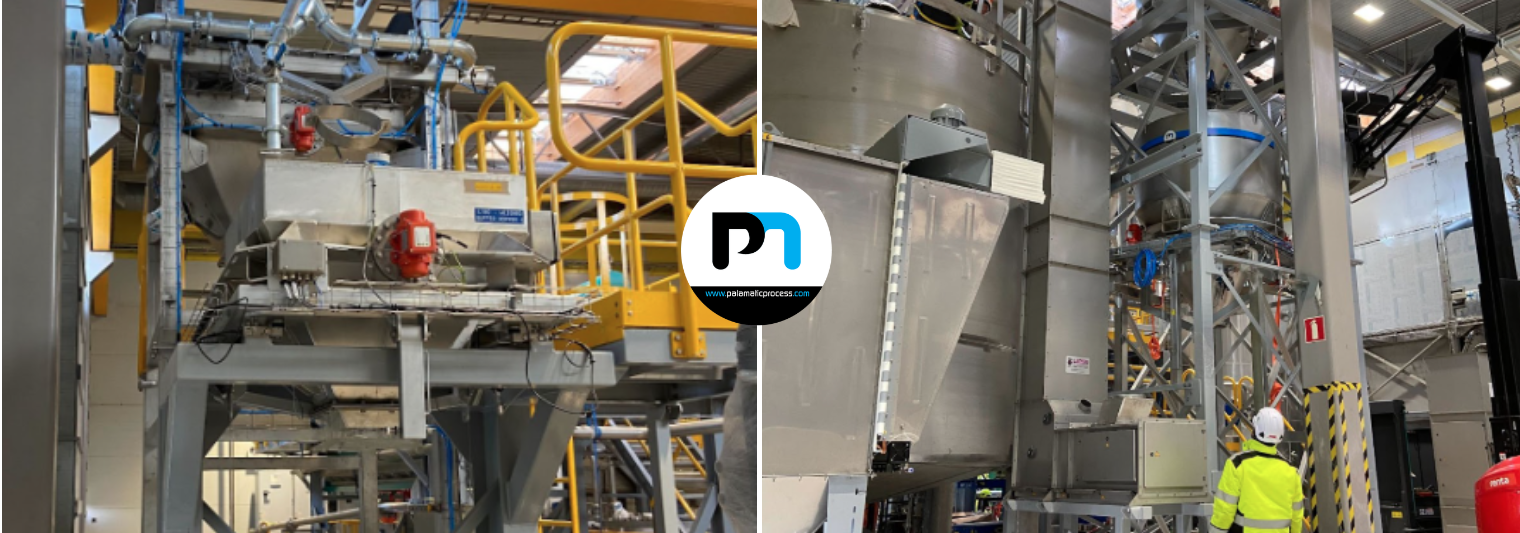
- 1. What is your definition of rare earths?
- 2. What are the challenges related to these rare earths?
- 3. How is your company, PALAMATIC PROCESS, an expert in powder handling and transfer, relevant to the subject of rare earths?
- 4. Do you have a specific client case study to share with us?
- 5. Are automation and robotics the future of rare earth handling?
- 6. Do any projects related to rare earths seem emblematic to you right now?
Essential to the energy transition, defence and digital technology, rare earths have become the new "grey gold" of the global economy. But beyond geopolitical tensions and extraction issues, there lies a major industrial challenge: the handling and transfer of these materials in the form of ultra-fine, reactive powders. How can we guarantee transfer without loss, contamination or risk to operators? We asked Guillaume from PALAMATIC PROCESS, a company specialising in powder handling and transfer. This business engineer and process solutions expert gives us his insight into the technological behind-the-scenes of a high-tension industry.
Q1. What is your definition of rare earths?
"Rare earths" refers to a group of 17 metals (scandium, yttrium, and the 15 lanthanides) extracted from mining facilities. Contrary to what their name suggests, they are not necessarily "rare" in the Earth's crust (cerium is more abundant than copper).
Their "rarity" comes from two critical factors:
- Dispersion: They are rarely found in concentrations sufficient for economically viable extraction.
- Complexity of separation: Their chemical properties are so similar that extremely sophisticated and repetitive processes are required to isolate them from each other.
In the industry, we often divide them into two categories: light rare earth elements (LREE) and heavy rare earth elements (HREE), the latter being the most valuable and the most difficult to source.
Q2. What are the challenges related to these rare earths?
The challenges related to these highly strategic minerals and metals, which are essential to many sectors, are threefold and touch the heart of modern industrial sovereignty:
- The Energy Transition challenge: Without rare earths (notably neodymium and praseodymium), there are no high-performance permanent magnets. Without these magnets, manufacturing electric vehicle motors and offshore wind turbines becomes nearly impossible.
- The Geopolitical challenge: Today, China controls a huge part of the value chain (extraction and especially refining). Europe and the United States are actively seeking to diversify their sources to guarantee their autonomy.
- The Environmental and Technical challenge: Refining is a heavy chemical process. The challenge is to develop "greener" extraction and recycling methods, with rigorous management of by-products and dust.
Furthermore, the subject is highly topical. The European Union, for example, has announced an ambitious 3 billion euro plan starting in 2026 to secure its supply of critical raw materials. The goal is to reduce dependence on China for rare earths. A new dedicated European center is set to be established, and this funding will also support strategic projects: extraction, refining, recycling.
In 2025, China reached its highest level of rare earth exports at 62,585 tons. Remember that these metals are used to manufacture electronic components, electric vehicle batteries, wind turbines, etc. The automotive, energy, and defense sectors are very keen on them. China is a key player. According to the International Energy Agency, 60% of the world's extracted rare earths come from this vast region of Asia, and 90% are even refined there!
Q3. How is your company, PALAMATIC PROCESS, an expert in powder handling and transfer, relevant to the subject of rare earths?
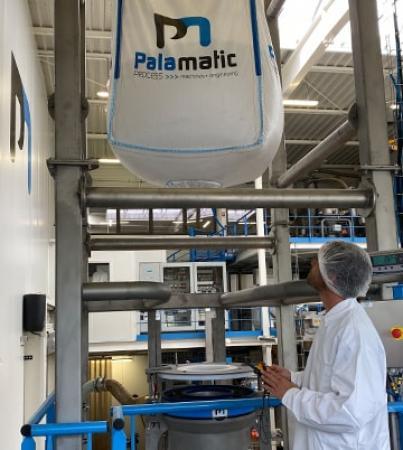
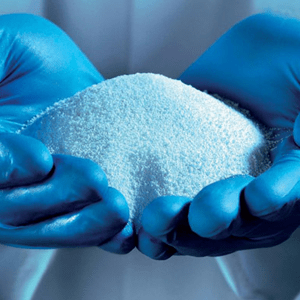
This is where our know-how becomes crucial. Once extracted and refined, rare earths come in the form of ultra-fine powders, often abrasive, dense, or reactive. Since 1992, at PALAMATIC PROCESS, we have been developing fully automated process lines for major international industrial accounts in all sectors of activity, particularly for very complex powders and rare earths. Our relevance is based on three pillars:
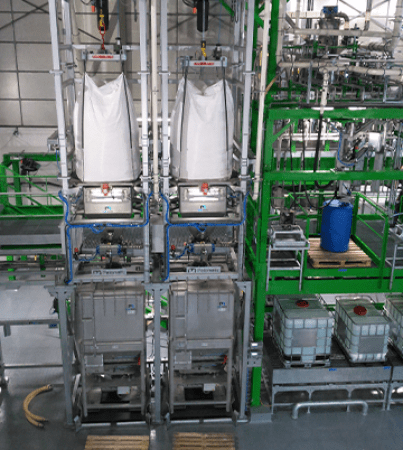
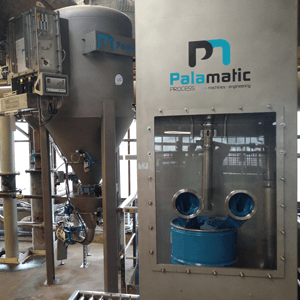
- Total containment: These powders are very expensive and can be toxic to inhale. Our dense-phase pneumatic transfer systems guarantee zero dust emissions into the working atmosphere.
- Preservation of integrity: Certain rare earths are sensitive to oxidation. We master transfer under an inert atmosphere (nitrogen) to avoid any product degradation during movement.
- Dosing precision: Given the market value of these materials, every gram counts. Our solutions allow high-precision dosing to feed manufacturing processes (magnetism, catalysis, optics).

Do you have a project?
I am available to advise and support you in your studies.
Guillaume DE CLERCQ, expert in powder
 +33 (0)2 99 86 06 22
 Contact our expert
Q4. Do you have a specific client case study to share with us?
Yes, absolutely! The powders of tomorrow will be increasingly technical and complex. As an expert for over 30 years in these raw materials, PALAMATIC PROCESS is currently responding to more and more customer requests regarding their rare earth challenges. For example, we can look at the optimization of a permanent magnet (NdFeB) production line.
The problem: A European manufacturer was experiencing significant material losses (dust) and oxidation issues during the manual transfer of Neodymium powder between the grinding stage and the press.
The solution: We installed a vacuum suction transfer system, fully automated and under neutral gas.
Result: 98% reduction in material losses.
- Safety improvement: elimination of operator exposure to fine dust.
- Quality: Perfect homogeneity of the final batch thanks to a gentle transfer that avoids particle segregation.
In conclusion, the success of the rare earth industry depends not only on the raw resource but on the performance of the processing chain. In a market where every gram of material has strategic and environmental value, there is no room for improvisation. Flow control, total containment, and automated transfer are no longer options, but sine qua non conditions for a competitive and responsible European industry. At PALAMATIC PROCESS, our role is to transform these logistical challenges into growth levers for our customers, providing absolute reliability where the material is most complex to master.
Did you know? Handling certain rare earths requires an inert gas environment (Nitrogen or Argon). In contact with oxygen, these powders can oxidize instantly, thus losing their magnetic properties.
Q5. Are automation and robotics the future of rare earth handling?
Absolutely. Robotization meets two major imperatives in our sector: protection and profitability.
- "Zero Contact": Certain rare earth powders are pyrophoric (ignite on contact with air) or irritating. Using robotic arms for loading/unloading hoppers or for handling containers (IBC) eliminates human risk.
- Dosing repeatability: A robot never tires. In high-performance alloy manufacturing, mixing precision to the nearest milligram is crucial. Robotics ensures that each batch is strictly identical to the previous one, drastically reducing the scrap rate of these costly materials.
Powder transfer is no longer a black box. With Factory 4.0, we are entering the era of intelligent flow.
- Predictive Maintenance: Thanks to IoT sensors on our installations, we monitor pipe wear (related to rare earth abrasion) or filter clogging in real-time. We intervene before a breakdown, avoiding critical production stops.
- Total Traceability: Every gram of rare earth is digitally traced from its entry into the transfer circuit to its final packaging. This is a strong argument for our clients who must justify the origin and responsible use of these minerals (ESG compliance).
- Digital Twin: We can simulate the behavior of the powder in our systems even before physical installation, thus optimizing energy consumption and airflow rates.
The biggest challenge in the short term is undoubtedly Urban Mining or recycling.
The technical challenge is immense: unlike virgin powder, material from recycling (old hard drives, crushed electric motors) is heterogeneous. It contains residues of plastics, other metals, and glues.
Our role is to adapt our technologies to treat these "hybrid powders" without blocking production lines. We are already working on sorting and pneumatic separation systems integrated into the transfer, allowing the material to be purified while it is moved. This is where the true circular economy of rare earths happens.
Q6. Do any projects related to rare earths seem emblematic to you right now?
The Lacq basin is becoming the nerve center of rare earths in Europe with two major complementary projects. Carester: this project named Caremag represents a global investment of 16 million euros (secured in 2025). The concept? It is a permanent magnet recycling plant and mineral concentrate refining facility. The stake is clear: it is a world first in terms of its scale. Caremag plans to produce 15% of the world demand for heavy rare earths (Dysprosium and Terbium) by the end of 2026. It is the typical model of a Factory 4.0 with zero liquid effluent and 80% recycled CO₂. In the USA, the Rare Earth (USAR) project represents an investment of approximately 130 million euros in public support. Announced in January 2026, the concept is led by an American company that chose to set up right next to Carester to transform oxides into metals and alloys. The announced capacity is 3,750 tons per year. Its entire challenge is to create a complete "waste to magnet" sector on a single French site.
On the La Rochelle side, the company Solvay promises the rebirth of a historic site, expert in rare earth separation, which is undergoing a radical mutation. An investment of over 100 million euros is committed to modernizing this unique site. The objective here is to create a major separation and purification hub for electric vehicle magnets. Solvay aims to cover 30% of European demand by 2030. The advantage? Unique expertise in Europe on complex chemical separation, a know-how that China was previously the only one to master on a large scale.
In the Allier region, the French State has decided to invest 50 million euros in the Imerys mining project named Emili, representing a minority stake of approximately 30%. A future underground lithium extraction mine is set to be built there, beneath an existing kaolin quarry at the Echassières site. Goal: 34,000 tons of lithium hydroxide per year. Enough to equip 700,000 electric vehicles.
The "Gigafactories" ecosystem in the North is not to be outdone! While rare earths are refined in the south, they are consumed massively in northern France, within the "Battery Valley." On site, for example, we find Verkor (Dunkirk) & ACC (Douvrin). These giant battery factories represent investments of several billion euros as final customers of these rare earths. These Gigafactories are now integrating short-loop battery and magnet recycling lines. They specifically need ultra-automated powder transfer systems to reinject recycled materials directly into the production of new cells.
👉 Do you have a project related to rare earths or the handling of complex powders? Our teams are at your disposal to study your technical challenges and support you toward a tailor-made, high-performance, and secure solution. Contact us!